

Masking
Electroplating Masking
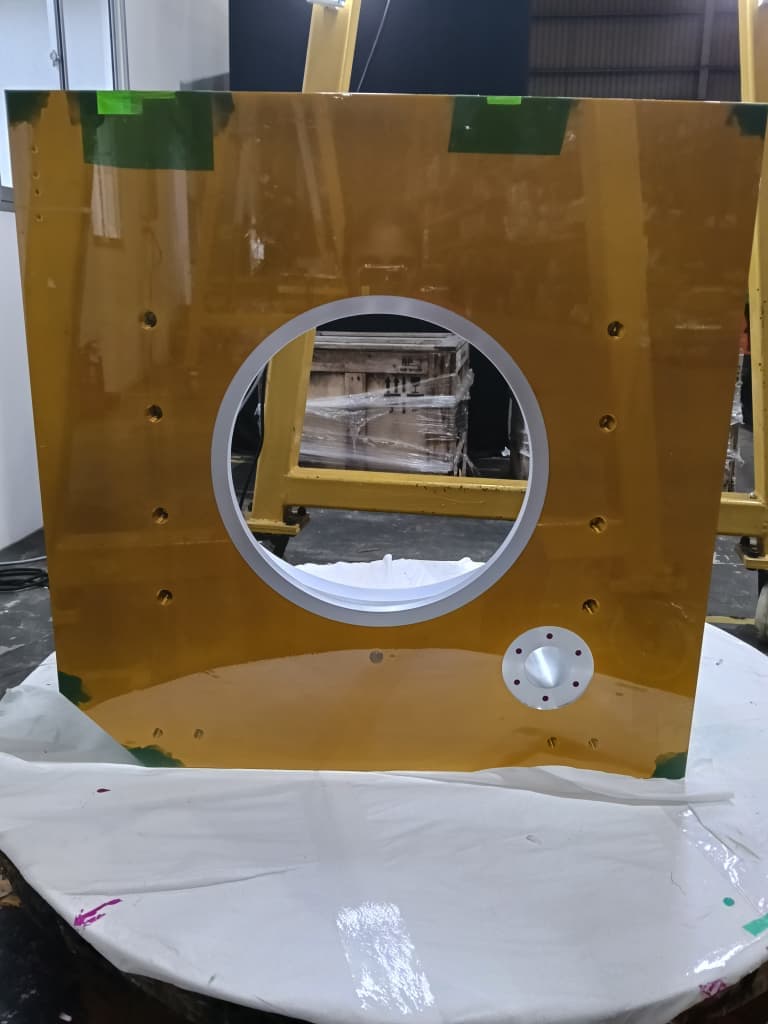
Masking metal parts for electroplating and anodising: what each stage asks of the tape, how to match tape to bath, and the range we slit, die-cut and supply.
What electroplating asks of a mask
Electroplating deposits a thin layer of one metal — nickel, chrome, zinc, tin, copper, gold — onto the surface of another by passing current through a bath. Wherever the part must stay bare, something has to keep the bath off it. That is the mask, and it rides through the whole line, not just the plating tank: alkaline degreasing, an acid pickle or activation dip, the plating bath itself, rinses, and sometimes a passivation or a bake afterwards.
Across that sequence the tape has to survive all of the following at once:
- Alkaline cleaners and acid dips before the bath, then a plating bath that is typically acidic — around pH 3 for common nickel and chrome chemistries — or alkaline for others
- Bath temperatures up to about 100 °C
- Immersion from a few hours to more than twenty in a single run
- Edge sealing tight enough that nothing wicks underneath — a mask fails at the edge long before the film gives up
- Conformability around holes, threads, radii and stepped faces
- Clean removal afterwards, with no adhesive left on the part for inspection or the next operation
Where tape does the work
Different points on the part call for different formats of the same material:
- Flat faces and large panels — wide tape applied in one piece. Every overlap is an extra edge for the bath to attack, so width matters as much as chemistry
- Holes, threaded ports and bores — die-cut discs and rings, sized to the feature, so the operator is not trimming tape by hand at the tank
- Edges, radii and stepped faces — narrow, conformable widths that follow the profile without bridging
- Selective plating and two-tone finishes — a straight, sharp edge where plated meets bare
- Contact and hanging points — small, precise masks that leave the electrical contact clear
- Demasking — strip in one pull with no residue, so the part goes straight to inspection
Matching the tape to the bath
Two things decide whether a masking tape survives: the film sets the temperature and chemical ceiling, and the adhesive decides whether the edge stays sealed when the bath is hot and wet. A tape can pass on film and still fail on adhesive — that is exactly what happened in the qualification described below.
- Polyimide film with silicone adhesive — for the hardest duty: hot acid, long immersion, clean removal. An 80 µm construction in this class qualified for production in the application described below, and it is what we specify when the bath is at the top of the range
- PET (polyester) film with silicone adhesive — high-temperature masking for baking, powder coating, milder plating conditions, and processes where the mask stays on through an oven
- Everyday green PET plating tape — the standard choice for short dips and lower-temperature baths. It is what most lines already run, and it is where to start when the process is undemanding
- Filmic masking tape for etching and light chemical exposure — withstands diluted acids and alkalis and gives a sharp edge on glass and metal
If your current tape lifts at the edge or leaves residue after the bath, the fix is usually a move up one tier — most often from an acrylic or rubber adhesive to silicone — rather than a different brand of the same construction.
What we supply and convert
- Slitting to width, from 1 inch up to 29 inches, so a large panel is masked with one piece instead of overlapping strips
- Die-cut discs, rings and shapes for holes, threads and ports, supplied ready to place
- Log rolls, custom lengths and small trial quantities
- Samples for line trials, with support through the customer's own qualification or DOE
- A full range across all four tiers — the exact tape is specified once we know your bath, not before
Proof: a qualification that went to production
A precision plating operation came to us with a green PET tape that leaked in a pH 3 bath at up to 100 °C over runs of twenty hours. A more heat-resistant film improved it but did not stop the leak; a silicone-adhesive polyimide tape did. It passed the customer's Design of Experiments and went into production at two plants over about seven months. The full account — process conditions, why the first two tapes failed, how the trial was run — is written up as a case study: Masking Tape for Precision Electroplating.
Start with three numbers
Tell us your bath chemistry or pH, the bath temperature, and the dwell time. From those we can say which construction should survive your line, and send samples so you can prove it on your own parts before you change anything. Contact us or reach us on WhatsApp.
Have a similar project in mind?
Bring us the challenge. Our technical team will help you scope the right material and converting solution.