

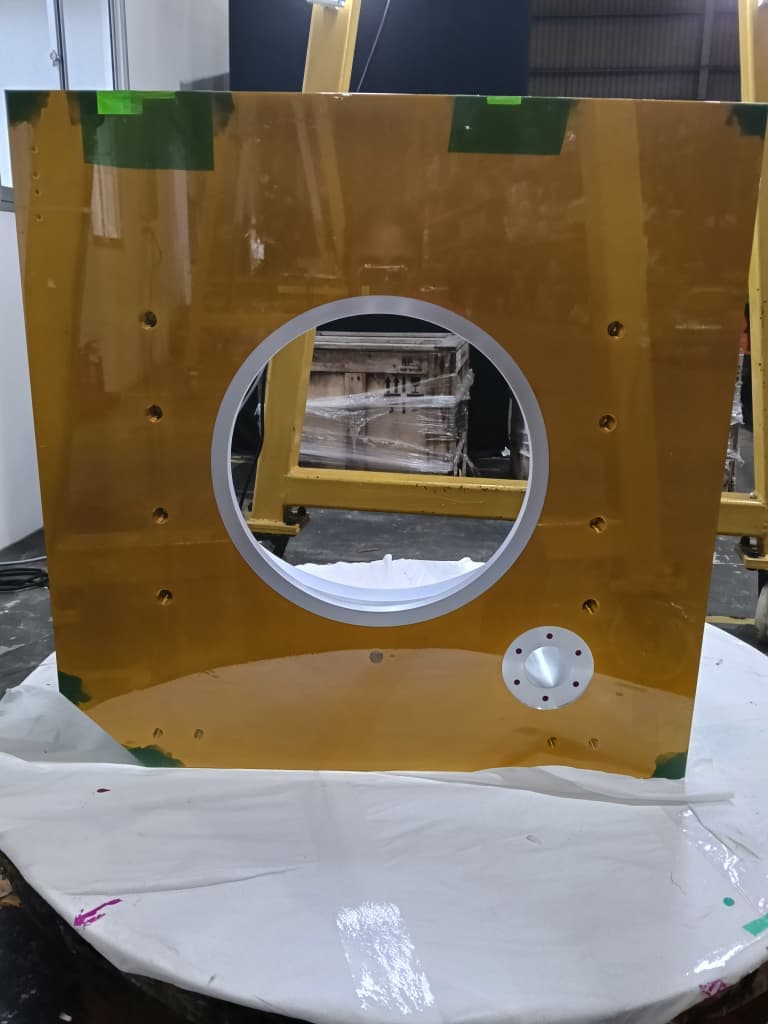
A precision electroplating operation came to us with a masking problem. They plate metal parts for semiconductor equipment, and the tape holding off the non-plated areas was leaking in the bath — plating creeping in where it had no business being. This is what the process actually demanded, and how we got from a failing tape to a qualified one. Customer and product identities are withheld; the process detail is what matters here.
The problem on the line
They were masking with a green polyester masking tape — the kind that works well for powder coating and paint. In a plating bath it did not hold. The bath crept under the edge, metal deposited on surfaces that were supposed to stay bare, and every affected part came back for stripping and rework. Masking failures of this kind are expensive twice over: once in the scrapped or reworked part, and again in the line time spent redoing it.
What the process actually demands
Electroplating puts a thin layer of one metal — nickel, chrome, zinc — onto the surface of another by electrochemistry. The tape's only job is to keep that layer off the areas that must stay bare. To do it, the tape has to survive the bath:
- An acidic bath at roughly pH 3
- Temperatures up to 100 °C
- Immersion from a few hours to more than 20 hours in a single run
- Clean removal afterwards, with no adhesive residue on the part
- Edge sealing good enough that nothing wicks underneath
That last pair is what separates plating masking from every other masking job. A tape can be chemically resistant and still fail, because the failure starts at the edge rather than in the middle of the film.
Why the first tape failed
Polyester masking tape is built for a different fight — short heat exposure, dry conditions, mechanical over-spray. Hold it in warm acid for twenty hours and the adhesive at the cut edge softens and loses grip before the film itself gives up. Once the bath finds that gap it travels, and the mask is done. Swapping to a more heat-resistant film helped, but the leak persisted: the carrier was no longer the limit, the adhesive was.
The tape that passed
What finally qualified was a polyimide (PI) film tape with a silicone adhesive:
- Polyimide film carrier — dimensionally stable and chemically inert at plating temperatures
- Silicone adhesive — holds its grip hot and wet, where acrylic and rubber systems let go
- 80 µm total thickness — thin enough to conform around holes and radii, thick enough to seal the edge
- Slit to width on demand, from 1 inch up to 29 inches, so large panels are masked in one piece instead of overlapping strips
The width range mattered more than it looks. Every overlap in a mask is another edge for the bath to attack, so being able to cover a panel with a single wide piece removes failure points rather than just saving time.
How the qualification ran
Roughly seven months from first enquiry to a scaled production order, in deliberate steps:
- Month 1 — First enquiry, for a green masking tape. Trial failed: leaking.
- Month 1 — Alternative proposed with a more heat-resistant film. Performance improved, leaking remained.
- Month 2 — Silicone-adhesive polyimide tape sampled. Trial passed with satisfactory masking. Quotation submitted and accepted.
- Month 3 — Trial order placed for a formal Design of Experiments.
- Month 4 — DOE passed.
- Month 6 — First production order placed and delivered, converting the development into business.
- Months 7–8 — Introduced at the customer's second plant, DOE passed there too, and the order scaled up.
Nothing here was fast, and it was not meant to be. A masking tape that fails in a plating bath is discovered on finished parts, so the customer was right to run a full DOE before committing a line to it.
What changed on the line
- Fewer masking defects — plating stays where it is supposed to be
- Higher plating yield, because fewer parts come back
- Less rework and stripping, and less cleaning of residue
- A more stable, more predictable process run to run
- Operators spend less time patching and double-taping edges
What actually made it work
The tape mattered, but so did how the trial was run:
- Samples out fast, so the line was never waiting on us to test an idea
- Understanding the real process — bath chemistry, temperature and dwell time — before recommending anything
- Choosing on the failure mode, not the datasheet: the second failure was an adhesive problem, not a film problem
- Following each trial closely instead of waiting for a verdict
- Answering quickly when something did not work, including when the answer was that our first proposal was wrong
Does your process look like this?
If you are masking for electroplating, anodising or any long immersion process and your current tape is lifting, leaking or leaving residue, the useful conversation starts with your bath chemistry, temperature and dwell time — not with a product code. Send us those three numbers and we will tell you what should survive them, and send samples to prove it.